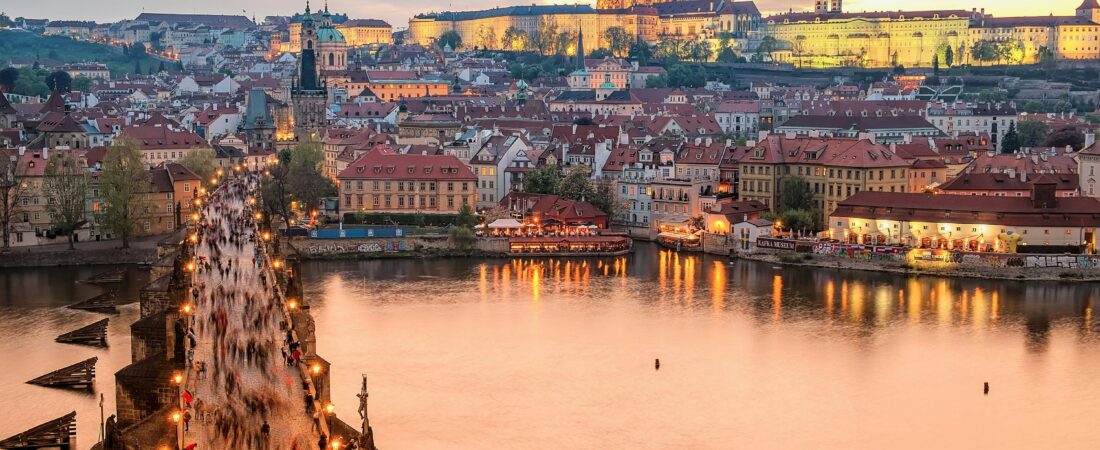
Four capital cities. Seven days. One of the greatest travel routes in Europe.
Prague, Vienna, Bratislava, and Budapest sit within a 500-kilometer stretch of Central Europe, all connected by fast, affordable trains. Together they represent the heart of the old Habsburg Empire — a region of extraordinary architecture, deep history, world-class food and beer, and some of the most beautiful city centers anywhere on the continent.
This itinerary is designed for first-time visitors who want to do the route properly: enough time in each city to go beyond the surface, logical train connections, and the kind of honest practical advice that makes the difference between a trip you remember and one you spend mostly lost or waiting.
The Route at a Glance
Prague (2 nights) → Vienna (2 nights) → Bratislava (1 night) → Budapest (2 nights)
This is the most logical direction — Prague and Vienna are connected by a 4-hour train, Vienna to Bratislava is 1 hour, and Bratislava to Budapest is 2.5 hours. You finish in Budapest, which has excellent flight connections home.
Alternatively, reverse the route and start in Budapest if that works better for your flights.
Before You Go: Essential Planning Notes
Trains: Book all train tickets in advance at Omio.com or Rail.cc. Prices are significantly cheaper when booked early. All connections on this route are direct.
Currency: Prague uses Czech Koruna (CZK); Vienna and Bratislava use Euro (€); Budapest uses Hungarian Forint (HUF). Use ATMs on arrival in each city — avoid airport exchange offices.
Best time to travel: April–June and September–October. Summer is beautiful but crowded and hot. December is magical for Christmas markets in all four cities.
Packing: Comfortable walking shoes are essential — all four cities have extensive cobblestone streets. A light day bag for city exploration. Layers for spring and autumn.
Day 1–2: Prague, Czech Republic
Getting There
Fly into Prague Václav Havel Airport (PRG). Take Bus 119 to Nádraží Veleslavín metro station, then Metro A to the city center (total ~35 minutes, ~€2).
Day 1: Old Town, Charles Bridge, and the Jewish Quarter
Arrive and check into your accommodation — ideally in the Old Town (Staré Město) or Malá Strana for easy access to everything.
Afternoon: Walk to Old Town Square to orient yourself. The Astronomical Clock, the Church of Our Lady before Týn, and the surrounding Baroque buildings are some of the finest in Europe. Climb the Old Town Hall Tower (€10) for panoramic views.
Walk north into Josefov — Prague’s historic Jewish Quarter, with six synagogues and the haunting Old Jewish Cemetery (combined ticket ~€20). The Spanish Synagogue and the layered gravestones of the cemetery are unmissable.
Evening: Head to the Náplavka riverbank for drinks with views, then dinner at Lokál Dlouhááá — the best traditional Czech pub in the city. Order svíčková (braised beef with cream sauce) and a perfectly poured Pilsner Urquell.
Day 2: Prague Castle and Malá Strana
Early morning: Cross Charles Bridge before 7am. At sunrise it’s one of the great European travel experiences — completely quiet, mist on the river, the castle glowing above. By 10am it’s packed.
Morning: Take Tram 22 up to Prague Castle — allow the full morning. Buy Circuit B (~€14) and visit St. Vitus Cathedral (don’t miss the Mucha window), the Old Royal Palace, and the Golden Lane where Kafka briefly lived.
Afternoon: Descend through the castle gardens into Malá Strana. Wander the cobblestone streets, find the Lennon Wall, visit the Church of St. Nicholas, and walk through the hidden Wallenstein Palace Garden with its peacocks and baroque fountains.
Evening: Classical concert at the Klementinum’s Mirror Chapel (~€30) — one of the most atmospheric venues in Prague.
Prague to Vienna: Day 3 Morning
Take an early train from Praha Hlavní Nádraží to Wien Hauptbahnhof (~4 hours, from €20). Book in advance on Omio or the ÖBB website. Trains run several times daily.
Day 3–4: Vienna, Austria
Arriving in Vienna
Wien Hauptbahnhof is about 10 minutes from the center by U-Bahn (line U1). Buy a 24-hour or 48-hour transit pass on arrival (~€8/€17).
Day 3: The Imperial Center
Afternoon (arriving ~1–2pm): Drop your bags and head straight to St. Stephen’s Cathedral (Stephansdom) in the center. The medieval Gothic masterpiece is free to enter; climb the South Tower (€5) for views.
Walk the Ringstrasse — the grand circular boulevard lined with monumental neo-Renaissance and neo-Gothic buildings: the State Opera, Parliament, City Hall, and the twin domed museums. Take Tram 1 or 2 if your feet need a rest.
Evening: Coffee house and culture. Café Central on Herrengasse is the most famous — order a Melange and apple strudel in a neo-Gothic room where Freud and Trotsky once sat.
If you planned ahead, standing room tickets at the Vienna State Opera cost €3–10 and are sold 80 minutes before the performance. One of the great bargains in European culture.
Day 4: Schönbrunn and the Belvedere
Morning: Take the U4 metro to Schönbrunn Palace — arrive early to beat the crowds. Austria’s most visited attraction is a magnificent Baroque complex with 1,441 rooms and sprawling formal gardens. Buy tickets online in advance. The Imperial Tour (~€18) covers the main rooms; walk up to the Gloriette for panoramic views over the city (free, gardens open early).
Lunch: Back toward the center at the Naschmarkt — Vienna’s famous open-air market. Graze through Austrian cheeses, fresh produce, and excellent street food.
Afternoon: The Belvedere Palace — two Baroque palaces connected by magnificent gardens. The Upper Belvedere houses Gustav Klimt’s The Kiss, arguably the most famous painting in Austria. Allow 2 hours. Entry ~€16.
Evening: Head to the 19th district for a Heuriger (wine tavern) experience. Sit under chestnut trees, drink local Grüner Veltliner poured from the barrel, and eat cold Austrian platters. Take the U4 to Heiligenstadt and look for a pine branch above the door.
Vienna to Bratislava: Day 5 Morning
Take the train from Wien Hauptbahnhof to Bratislava Hlavná Stanica (~1 hour, from €10). Trains run frequently. Alternatively, take the scenic Twin City Liner catamaran along the Danube (~€35 one way, 75 minutes) — a beautiful journey between the two cities.
Day 5: Bratislava, Slovakia
Bratislava gets a single day on most Central Europe itineraries — and that’s just enough to fall in love with it and wish you’d stayed longer.
Morning: Old Town and the Castle
Walk the compact Old Town (Staré Město) — from one end to the other in 15 minutes, but take at least two hours. Look for Čumil, the bronze man emerging from a manhole on Laurinská Street. Find Michael’s Gate, the only surviving medieval gate of the original city walls (climb it for €6). Wander into courtyards, notice the Baroque facades, and appreciate the almost surreal quiet compared to Prague or Vienna.
Then climb up to Bratislava Castle — the iconic white fortress with panoramic views over the Danube. The walk takes 20 minutes from the Old Town. Free to explore the grounds; €12 to enter the museum.
Lunch: Sit down at any traditional restaurant and order Bryndzové Halušky — potato dumplings with Slovak sheep cheese and bacon, the national dish. Budget €8–10.
Afternoon: UFO Bridge and Communist History
Walk across the SNP Bridge and take the elevator up to the UFO Observation Deck (€10) — 85 meters above the Danube, with 360-degree views over the city and across into Austria and Hungary.
If time allows, walk across the bridge into Petržalka — the enormous Soviet-era housing estate that’s home to more people than the entire historic city. The contrast with the Old Town is striking and fascinating.
Evening: Dinner and drinks in the Old Town. Bratislava has a surprisingly good nightlife scene — a half-liter of local beer costs €2–3, making it one of the cheapest evenings out in the eurozone.
Bratislava to Budapest: Day 6 Morning
Take the morning train from Bratislava Hlavná Stanica to Budapest Keleti (~2.5 hours, from €15). Trains run several times daily.
Day 6–7: Budapest, Hungary
Arriving in Budapest
Budapest Keleti station is connected to the city center by Metro M2. Buy a 24-hour or 48-hour transit pass on arrival (~€6.50/€13).
Day 6: Buda — The Castle and Gellért Hill
Morning: Take the historic funicular (€5 return) or walk up to Buda Castle. Allow the full morning — the castle complex contains the Hungarian National Gallery, the Budapest History Museum, and the extraordinary cave system beneath the castle (one of the best experiences in Budapest). Wander the Castle District and take in the views from the ramparts.
At Fisherman’s Bastion — the neo-Romanesque terraces just beside the castle — you get the single best view in Budapest: the Parliament across the Danube, the Chain Bridge below, the entire Pest skyline. Go early to avoid crowds.
Afternoon: Walk or take a tram south to Gellért Hill — a 30-minute climb through parkland with panoramic views from the top. At the base, the Gellért Thermal Baths are currently closed for renovation until 2028; visit Rudas Baths instead for a 16th-century Turkish bath experience with a spectacular Danube-view rooftop hot tub.
Evening: Cross back to Pest and head to the Jewish Quarter (District VII) — one of the most atmospheric neighborhoods in Central Europe. Start at Szimpla Kert, the original and best ruin bar, for drinks in an extraordinary space of multiple rooms, courtyards, and years of accumulated graffiti and decoration.
Day 7: Pest — Parliament, Markets, and Thermal Baths
Morning: Walk along the Pest bank of the Danube to the Hungarian Parliament — the most spectacular building in Budapest, best viewed from the riverside walk in the morning light. Book a guided interior tour in advance online (~€25) — it sells out. Even if you skip the tour, staring at the Parliament from the riverbank is free and extraordinary.
Mid-morning: Walk to St. Stephen’s Basilica (free entry) and then along Andrássy Avenue — Budapest’s grand UNESCO-listed boulevard. Take Metro Line 1 (Continental Europe’s oldest underground railway, from 1896) along the avenue to Heroes’ Square at the far end.
Afternoon: Széchenyi Thermal Baths in City Park — the most famous of Budapest’s 100+ thermal baths, set in a magnificent yellow Baroque palace. Allow 3 hours minimum. Entry ~€30–35. Go on a weekday to avoid weekend crowds. Bring flip-flops and a towel or pay extra at the door.
Evening: Danube Night Cruise from the Pest riverbank (~€15–25, 1–1.5 hours). Budapest lit up at night from the water is one of the great European views — the Parliament, Buda Castle, the Chain Bridge, and all the illuminated facades reflecting on the river. Book in advance.
Final dinner in the Jewish Quarter — try chicken paprikash (tender chicken in creamy paprika sauce with egg noodles) or a proper goulash soup at one of the neighborhood’s traditional Hungarian restaurants.
7-Day Itinerary Summary
| Day | City | Highlights |
|---|---|---|
| Day 1 | Prague | Old Town Square, Jewish Quarter, Náplavka |
| Day 2 | Prague | Charles Bridge at sunrise, Prague Castle, Malá Strana |
| Day 3 | Vienna | Train from Prague, Stephansdom, Ringstrasse, Opera |
| Day 4 | Vienna | Schönbrunn Palace, Naschmarkt, Belvedere + The Kiss |
| Day 5 | Bratislava | Old Town, Castle, UFO Bridge, local beer |
| Day 6 | Budapest | Buda Castle, Fisherman’s Bastion, Gellért Hill, Ruin bars |
| Day 7 | Budapest | Parliament, Andrássy Avenue, Thermal Baths, Night Cruise |
Train Connections and Costs
| Route | Duration | Price (from) | Book at |
|---|---|---|---|
| Prague → Vienna | ~4 hours | €20 | Omio / ÖBB |
| Vienna → Bratislava | ~1 hour | €10 | Omio / ÖBB |
| Vienna → Bratislava (boat) | 75 min | €35 | twincityliner.com |
| Bratislava → Budapest | ~2.5 hours | €15 | Omio / MÁV |
Book all tickets at least 2–3 weeks in advance for the best prices.
Budget Breakdown for 7 Days
| Category | Budget (€) | Mid-range (€) |
|---|---|---|
| Accommodation (7 nights) | 140–210 | 420–700 |
| Food and drink | 140–200 | 250–350 |
| Activities and entrance fees | 80–120 | 150–200 |
| Train tickets | 45–65 | 65–90 |
| Local transport | 30–40 | 40–60 |
| Total | €435–635 | €925–1,400 |
This route offers exceptional value by Western European standards. Prague and Budapest in particular are among the most affordable capital city experiences in Europe.
Practical Tips
- Book Prague Castle and Vienna’s Schönbrunn in advance — both have timed entry and sell out in peak season
- Carry some cash in each country — Czech Koruna, Euro, and Hungarian Forint are all different currencies
- Prague and Budapest have the best budget food — use lunch menus (denné menu in Slovakia, napi menü in Hungary) for €5–8 full meals
- Bratislava is the surprise of the route — most people expect little and leave wanting to return
- Store luggage at train stations between check-out and your train departure — all four cities have left luggage facilities
Want to Go Deeper?
We have complete guides for each city on this route:
- Best Things to Do in Prague and 3 Days in Prague Itinerary
- Best Things to Do in Vienna and 3 Days in Vienna Itinerary
- Best Things to Do in Bratislava and 3 Days in Bratislava Itinerary
- Best Things to Do in Budapest and 3 Days in Budapest Itinerary
You might also like:
- 10 Most Underrated Cities in Europe Worth Visiting in 2026
- Budapest vs Bratislava: Which City Should You Visit First?
- Best Things to Do in Kraków: Poland’s Royal Capital