Vienna is one of the best-located cities in Europe for day trips. Within three hours in any direction you have Austria’s alpine lakes, the birthplace of Mozart, Slovakia’s charming capital, the Hungarian thermal bath scene, and some of the finest wine country on the continent.
Whether you want alpine scenery, historical depth, another city entirely, or a quiet afternoon in wine country, Vienna delivers more day trip options than almost anywhere else in Europe. This guide covers the best of them — honestly ranked, with practical transport information and tips for making the most of each.
Day Trips at a Glance
| Destination | Distance | Travel time | Best for |
|---|---|---|---|
| Bratislava, Slovakia | 80 km | 1 hour by train | City, history, cheap beer |
| Hallstatt | 280 km | 3.5–4 hours | Alpine scenery, photography |
| Salzburg | 300 km | 2.5 hours by train | Mozart, baroque city, Sound of Music |
| Wachau Valley | 90 km | 1 hour by train | Wine, castles, river scenery |
| Krems an der Donau | 75 km | 1 hour by train | Wine, quiet town, day hikes |
| Budapest, Hungary | 240 km | 2.5 hours by train | Thermal baths, ruin bars |
| Klosterneuburg | 12 km | 30 min by train | Monastery, vineyard views |
| Baden bei Wien | 26 km | 45 min by train | Spa town, gardens, thermal baths |
1. Bratislava, Slovakia — Best City Day Trip
Bratislava is the easiest and most rewarding city day trip from Vienna — just 60 minutes by train, and a completely different world.
Slovakia’s capital is compact, charming, and genuinely surprising. Most people arrive expecting little and leave wishing they’d stayed longer. The medieval Old Town is entirely walkable in an afternoon, the castle views over the Danube are excellent, and at Slovak prices you can have a full lunch and several beers for less than a single coffee in Vienna.
Insider tip: Climb to the top of Devín Castle for one of the most scenic Vienna to Bratislava day-trip photo spots. Devín is just 12 km from Bratislava’s Old Town — take bus 29 from the city center.
What to do in a day:
- Walk the Old Town and find the bronze statues (Čumil the manhole man on Laurinská Street)
- Climb to Bratislava Castle for panoramic Danube views
- Have lunch with Bryndzové halušky (Slovak sheep cheese dumplings) for €8
- Walk across the UFO Bridge and take the elevator to the observation deck
- Take bus 29 to Devín Castle ruins above the river
Getting there: Direct trains from Wien Hauptbahnhof to Bratislava Hlavná Stanica run roughly every hour. Journey time ~1 hour, from €10 each way. Book on the ÖBB website or Omio.
Alternatively: The Twin City Liner catamaran travels along the Danube between Vienna and Bratislava in 75 minutes (~€35 one way) — scenic and worth it once.
Read our full guide: Best Things to Do in Bratislava
2. Hallstatt — Most Spectacular Scenery
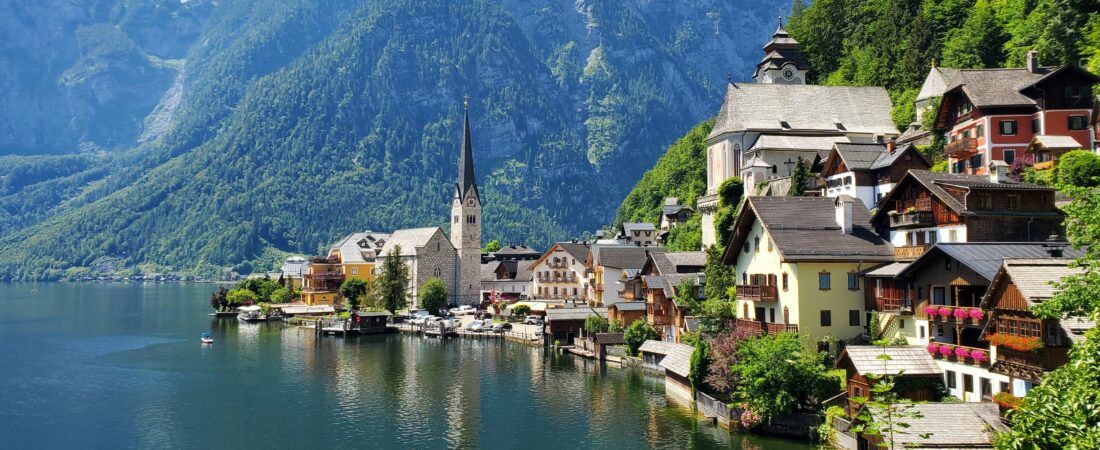
Hallstatt’s beauty is the stuff of fantasy, with its peaceful atmosphere, serene lake and charming architecture. It is thought to be one of the inspirations behind Disney’s Frozen.
The tiny lakeside village of Hallstatt — a cluster of colorful cottages on the edge of a deep alpine lake, with mountains rising directly behind — is genuinely one of the most photographed places in Europe. Both the village and the lake are UNESCO World Heritage Sites.
The honest note: Hallstatt is very popular and can feel crowded in peak summer. The solution is arriving early (before 9am) or visiting in shoulder season (May–June or September). The beauty of the place is real and extraordinary regardless.
What to do:
- Walk through the village and along the lake shore
- Visit the Hallstatt Skywalk viewpoint on Mount Krippenstein for aerial views over the village and lake
- See the Charnel House — a small 12th-century chapel decorated with painted skulls, unique in the Alpine world
- Take a boat trip on the lake
- Visit the Hallstatt Salt Mine — one of the oldest salt mines in the world, with a thrilling mine slide
Getting there: No direct train to Hallstatt. Take the train from Wien Hauptbahnhof to Hallstatt Bahnhof (~3 hours), then a short ferry across the lake to the village. Total journey 3.5–4 hours each way. Alternatively, several organized day trips run from Vienna (~€60–80 per person including transport).
Honest advice: The journey is long for a day trip. Consider staying overnight in Hallstatt or a nearby village (Bad Ischl, Obertraun) to make the most of it.
3. Salzburg — Best Cultural Day Trip
One of the most popular destinations is Salzburg, where Mozart, mountain views, and Sound of Music vibes await.
Salzburg is Mozart’s birthplace and one of the finest Baroque cities in Europe — a compact, walkable historic center of domed churches, palaces, and the Hohensalzburg Fortress looming above it all. It’s genuinely beautiful and the Sound of Music connection (the film was shot here) adds an additional layer of cultural interest.
What to do in a day:
- Walk through the Getreidegasse — the Old Town’s most famous shopping street, where Mozart was born at number 9
- Visit Mozart’s Birthplace (Mozarts Geburtshaus) — the apartment where he was born in 1756, now a museum (~€12)
- Climb to Hohensalzburg Fortress — the largest fully preserved medieval castle in Central Europe, with extraordinary views over the city (~€15 for funicular and entry)
- Walk through Mirabell Palace and Gardens — the formal baroque gardens used in The Sound of Music filming
- Have lunch at the Salzburg Christkindlmarkt (December) or a traditional Austrian restaurant year-round
Getting there: Direct trains from Wien Hauptbahnhof to Salzburg Hauptbahnhof run regularly. Journey time ~2.5 hours, from €30 each way. Book in advance on ÖBB.
Honest advice: Salzburg deserves more than a day. If you can, stay overnight — the city at dawn before the tourists arrive is extraordinary.
4. Wachau Valley — Best Wine and Scenery
The Wachau Valley stretches eighteen miles along the Danube River between Krems and Melk, and is lined with picturesque villages, ancient castles and some of the country’s best vineyards.
The Wachau is Austria’s most celebrated wine region and one of the most beautiful stretches of the Danube anywhere — terraced vineyards on steep hillsides, medieval villages of apricot orchards and wine cellars, ancient castles and the magnificent Melk Abbey rising dramatically above the river.
The classic Wachau day trip:
- Train from Vienna to Krems (1 hour, from €15)
- Cycle or take a boat along the Danube to Spitz, Weißenkirchen, and Dürnstein — stopping at wine cellars along the way
- Visit Ruine Dürnstein — the castle where Richard the Lionheart was imprisoned in 1192 (20-minute hike, free entry, spectacular views)
- Visit Melk Abbey — one of the most impressive Baroque monasteries in Europe, built on a cliff above the Danube (~€14 entry)
- Return by train from Melk to Vienna (1 hour)
Getting there: Train from Wien Hauptbahnhof to Krems (1 hour, from €15) or Melk (1 hour, from €15). Bikes can be rented in Krems and Melk.
Best time: May–June when the apricot trees bloom, or September–October during the wine harvest.
5. Budapest, Hungary — Best Thermal Bath Day Trip
Budapest is 2.5 hours from Vienna by direct train — doable as a day trip for the adventurous, but better as an overnight. If you’re doing it in a day, the thermal baths and a walk along the Danube riverfront are the priorities.
What to do in a Budapest day trip:
- Walk along the Pest bank of the Danube to the Parliament building — one of the most spectacular buildings in Europe
- Cross the Chain Bridge on foot
- Spend the afternoon at Széchenyi Thermal Baths in City Park (~€34 entry) — the most iconic thermal bath experience in Budapest
- Walk through the Jewish Quarter and have dinner at one of the ruin bars
Getting there: Direct trains from Wien Hauptbahnhof to Budapest Keleti run several times daily. Journey time ~2.5 hours, from €20 each way. Book in advance on Omio or the MÁV website.
Honest advice: Budapest deserves at least 2–3 days. A day trip is barely enough to scratch the surface. If you’re visiting Vienna and haven’t been to Budapest, consider an overnight extension rather than a day trip.
Read our full guide: Best Things to Do in Budapest
6. Klosterneuburg — Easiest Day Trip
Just 12 km from Vienna, Klosterneuburg is the most accessible day trip from the Austrian capital — 30 minutes by suburban train (S40 from Franz-Josefs-Bahnhof, from €4 return) and a complete change of pace.
The Klosterneuburg Monastery is an extraordinary Augustinian monastery built on a hill above the Danube — a massive complex of Baroque buildings, a Gothic cloister, and the Babenberg Vault with Habsburg imperial regalia. The monastery also produces excellent wine from its own vineyards.
The town itself is pleasant and quiet — a good choice for a half-day away from the city without the travel time of longer options.
Getting there: S40 suburban train from Wien Franz-Josefs-Bahnhof. 30 minutes, €4 return.
7. Baden bei Wien — Spa Town Day Trip
Baden bei Wien is a genteel spa town 26 km south of Vienna, where the Viennese have been coming to take the waters since Roman times. Beethoven spent 15 summers here; Emperor Franz Joseph was born here; and the thermal baths are still operating.
The town is elegant and unhurried — a Biedermeier townscape of pastel facades, a rose garden with over 600 varieties, and the Kurpark (spa park) that feels like a step back into the 19th century.
Getting there: Baden Schnellbahn from Wien Oper/Karlsplatz runs every 15 minutes. Journey time ~45 minutes, ~€6 return.
What to do: Walk the Kurpark, visit the Beethovenhaus (the apartment where he wrote the Ninth Symphony, ~€5), and take a session at the Römertherme thermal baths (~€19 for 3 hours).
8. Krems an der Donau — Wine and Walking
Krems is the gateway to the Wachau Valley and a charming small town in its own right — a well-preserved medieval Old Town, an excellent Kunsthalle Krems contemporary art museum, and the start of the best cycling route along the Danube.
It’s less dramatic than Hallstatt and less famous than Salzburg, but for a relaxed day of wine tasting, walking, and cycling along the river, Krems delivers everything you need.
Getting there: Direct train from Wien Franz-Josefs-Bahnhof. Journey time ~1 hour, from €15. Bikes available for rent at the station.
Practical Tips for Vienna Day Trips
Book trains in advance — prices on ÖBB (Austrian Federal Railways) are significantly cheaper when booked early. Same-day tickets can cost two to three times the advance price on popular routes like Vienna–Salzburg.
The ÖBB Österreich-Ticket — a day pass for unlimited train travel within Austria costs around €45. If you’re doing a full day trip to Salzburg and back (normally €60+ return), it pays for itself.
Start early — most day trip destinations get busier as the day goes on. Arriving at Hallstatt before 9am or Salzburg before 10am gives you a completely different experience to arriving at noon.
Vienna City Card — covers unlimited public transport within Vienna plus discounts at many attractions. Useful for days when you’re staying in the city but not necessary for day trips.
Motion sickness note: Some day trips to the Austrian Alps involve high, winding mountain roads. If you’re prone to motion sickness, sit near the front of any bus or consider a private transfer.
The Best Day Trip for Each Type of Traveler
For city lovers: Bratislava — a completely different city, one hour away, at a fraction of Vienna’s prices.
For nature and scenery: Hallstatt — yes, it’s a long journey, but the scenery is extraordinary.
For culture and history: Salzburg — Mozart, Baroque architecture, and the Sound of Music in one compact city.
For wine lovers: Wachau Valley — the most beautiful stretch of the Danube, with excellent Grüner Veltliner and Riesling at the source.
For a relaxed half-day: Klosterneuburg — 30 minutes by train, a magnificent monastery, and back in Vienna for dinner.
For the full Central Europe experience: Budapest — pair with an overnight and you’ve done the best two-city combination in Central Europe.
Final Thoughts
Vienna’s location in the heart of Central Europe makes it one of the finest bases for day trips on the continent. Within three hours by train you have the alpine drama of Salzburg and Hallstatt, the wine culture of the Wachau, the affordable charm of Bratislava, and the thermal baths and ruin bars of Budapest.
If you have more than three days in Vienna, use at least one of them to leave the city. The day trips are part of what makes Vienna extraordinary.
Planning your Vienna trip? Read our complete Vienna travel guide and 3-day Vienna itinerary for everything you need to know about the city itself. For the full Central Europe route, read our 7-Day Central Europe Itinerary.
You might also like:
- Best Things to Do in Bratislava: Slovakia’s Underrated Capital
- How to Travel Europe by Train on a Budget: The Complete Guide
- The Perfect 7-Day Central Europe Itinerary: Prague, Vienna, Bratislava & Budapest