Kraków is one of those cities that keeps surprising you. You arrive expecting a pretty medieval town with good pierogi, and you leave three days later having visited one of the most important historical sites in the world, eaten some of the best food in Central Europe, and — if you played your cards right — experienced what might genuinely be the best nightlife scene on the continent.
Poland’s former royal capital is the complete package: a UNESCO-listed Old Town that survived World War II almost completely intact, a Jewish Quarter of extraordinary depth and atmosphere, day trips that will stay with you for a lifetime, and an after-dark scene that has earned a devoted following among backpackers, Erasmus students, and anyone who’s stumbled across it by accident.
This guide covers the 15 best things to do in Kraków — from the historic to the hedonistic.
Why Visit Kraków?
Kraków is the former royal capital of Poland and sits on the Vistula River in the south of the country. For centuries it was the heart of Polish culture, politics, and religion — home to one of the oldest universities in Europe, the seat of Polish kings, and a city that somehow avoided the almost total destruction that Warsaw suffered in World War II.
The result is a medieval city center of extraordinary integrity — Gothic churches, Renaissance architecture, Baroque palaces, and a main market square that is the largest medieval square in Europe — all largely as it was centuries ago.
It’s also one of the most affordable cities in Central Europe. A beer costs around €2, a full restaurant meal €8–12, and even a luxury hotel rarely tops €100 a night. For the quality of experience on offer, Kraków is one of the best value destinations in Europe.
1. Main Market Square (Rynek Główny)
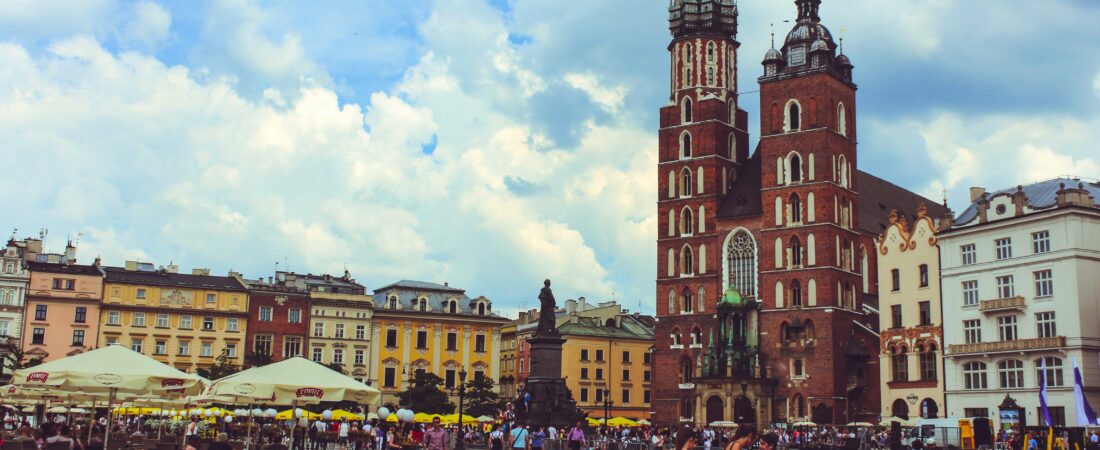
The heart of Kraków and one of the great public spaces in Europe, Rynek Główny is the largest medieval market square on the continent — 200 meters on each side, ringed by Gothic and Renaissance townhouses, church spires, and outdoor café terraces.
At the center stands the Cloth Hall (Sukiennice) — considered the world’s oldest shopping mall, a Renaissance structure dating from 1555, with market stalls selling amber jewelry, Polish crafts, and souvenirs inside, and café terraces spilling out on all sides. Beneath the square, the Rynek Underground Museum reveals the medieval city layer by layer through archaeological excavations (entry ~€10 — book online in advance).
The square is best experienced at different times of day: morning for a quiet coffee, afternoon for people-watching, evening when the restaurants light up and the whole space takes on a different character.
2. Wawel Royal Castle
Perched on Wawel Hill above the Vistula River, Wawel Royal Castle is the most important historical site in Poland — the seat of Polish kings for centuries and the spiritual heart of the nation.
The castle complex contains the Royal Apartments (opulent state rooms with original furnishings and a treasury displaying Poland’s medieval crown jewels), the Wawel Cathedral (where Polish kings were crowned and buried — the crypt contains the tombs of national heroes including Tadeusz Kościuszko and Adam Mickiewicz), and the legendary Dragon’s Den — a 270-metre cave in the hill, steeped in local folklore, where you exit next to a fire-breathing dragon sculpture on the riverbank.
Buy tickets online in advance — entry to different parts of the complex requires separate tickets. Allow half a day for the full site. Entry to the castle grounds is free; the individual attractions cost around €5–10 each.
3. Kazimierz — The Jewish Quarter
Kazimierz is one of the most fascinating and atmospheric neighborhoods in Central Europe. For centuries it was one of the most important centers of Jewish life in Europe; today it’s a neighborhood of extraordinary layers — synagogues and Jewish heritage alongside independent cafés, vintage shops, street art, and the best nightlife in the city.
Key sites:
- Old Synagogue — the oldest surviving synagogue in Poland, now a museum of Jewish history (entry ~€8)
- Remuh Synagogue and Cemetery — still active, with a 16th-century cemetery containing some of the most important Jewish gravestones in Europe
- Galicia Jewish Museum — a powerful photographic exhibition documenting surviving traces of Jewish culture in southern Poland
- Plac Nowy — the neighborhood’s central square, home to a circular market hall and the best street food in Kraków (try the zapiekanka — an open-faced baguette with mushrooms and cheese, the Kraków street food classic)
Allow at least half a day. Come back in the evening — Kazimierz transforms after dark into the city’s best nightlife district.
4. Auschwitz-Birkenau Memorial
This is not a typical tourist attraction. It’s one of the most important places of memory in the world, and visiting it is a profoundly serious experience. But if you’re in Kraków, going is almost an obligation.
The Auschwitz-Birkenau Memorial and Museum — about 70 km west of Kraków — is the largest Nazi concentration and extermination camp, where over 1.1 million people, predominantly Jewish, were murdered between 1940 and 1945. The site is preserved largely as it was left, including the gas chambers, the crematoria ruins, and the vast scale of the Birkenau camp.
Book a guided tour in advance — it’s strongly recommended over self-guided visits for the historical context. Tours from Kraków run daily and typically include transport (around €40–50 total). Allow a full day.
It is heavy, important, and unforgettable. Go.
5. Wieliczka Salt Mine
Just 14 km from Kraków, the Wieliczka Salt Mine is one of the most extraordinary underground sites in Europe — a UNESCO World Heritage Site that has been continuously mined since the 13th century, reaching a depth of 327 meters and containing 287 km of tunnels.
What makes it extraordinary is what the miners carved inside: chapels, sculptures, bas-reliefs, and an entire underground cathedral — the Chapel of St. Kinga — all carved from rock salt, with salt-crystal chandeliers and life-sized Biblical scenes. It’s simultaneously geological, historical, and deeply strange.
Tours run regularly from Kraków (15–30 minutes by bus or minibus). Entry costs around €25 for the tourist route. Book online in advance in summer — it fills up fast. Allow 3–4 hours.
6. St. Mary’s Basilica
On the eastern side of the Main Market Square, St. Mary’s Basilica is Kraków’s most important Gothic church, famous for its extraordinary wooden altarpiece by Veit Stoss — the largest Gothic altarpiece in the world, carved between 1477 and 1489. The interior is a riot of color: Gothic vaulting painted deep blue with gold stars, medieval stained glass, and the Stoss altarpiece dominating the high altar.
Every hour on the hour, a bugler plays the Hejnał Mariacki — a traditional melody cut off mid-phrase in memory of a medieval trumpeter shot by a Tatar arrow while sounding the alarm. Listen for it from the square.
Entry to the basilica costs around €10. Book timed entry online in summer.
7. The Barbican and Florian’s Gate
The Barbican is one of the best-preserved medieval fortifications in Europe — a circular brick fortification built in 1499 to defend the northern entrance to the city. Just behind it, Florian’s Gate is the most beautiful of Kraków’s surviving medieval towers, its Gothic spire rising above the Royal Road that once led to Wawel Castle.
Walk through the gate and down Floriańska Street — the Royal Road, lined with beautiful townhouses — all the way to the Main Market Square. It’s a 10-minute walk and the best introduction to Kraków’s Old Town.
Entry to the Barbican is around €6. The gate and the Planty Park surrounding the Old Town are free.
8. Oskar Schindler’s Factory
The Oskar Schindler Factory in the Podgórze district is now one of the best museums in Poland — a modern, immersive exhibition telling the story of Kraków’s occupation during World War II, using the actual factory where Schindler saved over 1,200 Jewish workers from the death camps. It’s also the location that inspired Steven Spielberg’s Schindler’s List, parts of which were filmed in Kraków.
The exhibition is brilliantly designed, deeply moving, and takes 2–3 hours. Entry costs around €16. Book online — it sells out, especially in summer. The factory is a 20-minute walk from Kazimierz across the Vistula.
9. Nowa Huta
Nowa Huta is one of the most unusual neighborhoods in Central Europe — a complete socialist realist city built from scratch by the communist regime in the 1950s as a model workers’ district, designed to dilute the bourgeois and intellectual influence of historic Kraków with a large working-class population.
Wide Soviet-style boulevards, identical apartment blocks radiating from a central square (now renamed after Ronald Reagan), a giant steelworks still partially in operation — it’s unlike anything else in Kraków and gives a fascinating glimpse into communist urban planning.
Take Tram 4 from the Old Town (about 30 minutes). Entry to the neighborhood is free. Several companies offer guided tours of Nowa Huta including a ride in a vintage communist-era Fiat 126 (the legendary “Maluch”) — highly recommended for the experience.
10. Planty Park
Planty Park is a ring of green parkland that completely encircles Kraków’s Old Town — built on the site of the medieval city walls that were demolished in the early 19th century. It’s about 4 km in circumference and connects all the Old Town attractions in a continuous green belt.
Walking the full Planty circuit takes about an hour. It’s free, beautiful in all seasons, and the best way to understand the scale of the Old Town. In spring the chestnut trees bloom; in winter it’s dusted with snow.
11. The Dragon Legend and Wawel Hill at Sunset
Beyond the castle, Wawel Hill at sunset is one of the best free experiences in Kraków. The hilltop offers sweeping views over the Vistula River and the city, and as the sun drops the castle and cathedral are bathed in golden light.
Look for the Dragon’s Den entrance on the riverbank below — the cave associated with the legendary Wawel Dragon, which according to Polish mythology terrorized the city until a clever cobbler tricked it into eating a sheep stuffed with sulfur. The dragon sculpture outside breathes real fire every few minutes. Free to watch, €5 to enter the cave.
12. Kraków’s Food Scene
Polish food is one of Europe’s most underrated culinary traditions, and Kraków is the best place to discover it.
Must-try dishes:
- Pierogi — stuffed dumplings, boiled or fried, with fillings ranging from potato and cheese to meat, mushroom, and spinach. Every restaurant serves them; the best are at Pierogi Mr Vincent near the Old Town.
- Żurek — a sour rye soup served in a bread bowl, with hard-boiled egg and sausage. Hearty and deeply Polish.
- Bigos — hunter’s stew of cabbage, sauerkraut, and various meats. Poland’s national dish.
- Zapiekanka — the Kraków street food classic, found at Plac Nowy in Kazimierz: a toasted baguette half topped with mushrooms, cheese, and ketchup. Sounds simple; tastes extraordinary at midnight after a night out.
- Obwarzanek — the Kraków bagel, sold from street carts throughout the city for around €0.50. Eat one while walking through the Old Town.
For budget meals, look for bar mleczny (milk bars) — communist-era self-service canteens still operating throughout the city, serving traditional Polish food for €3–5 a meal.
13. The Nightlife — Europe’s Best Kept Secret
I’ve traveled extensively across Europe specifically looking for good nightlife, and Kraków ranks number one on my personal list. The combination of a huge student population, a massive Erasmus community, and an extraordinarily affordable beer scene creates something special.
The action is centered on Kazimierz — particularly around Plac Nowy — and the Old Town streets around Św. Jana and Floriańska. Beer from around €2, entry to most clubs free or minimal.
The standout experience is Mundo Hostel — home to the legendary Cuban Theatre Bar. Every night brings surprise shots and daily beer pong tournaments. At weekends, they run a pub crawl that is genuinely one of the best nightlife experiences I’ve found in Europe: free entry to the best clubs in the city, open bar included, and the kind of international crowd that means you’ll be exchanging Instagram handles with people from six different countries by 2am. If you’re staying in a hostel or traveling solo, this pub crawl is unmissable.
For clubs: the basement and underground scene is extraordinary — multiple rooms, themed spaces, and the occasional token-payment system that keeps bar queues nonexistent. Some venues run until 6am on weekends.
14. Day Trip to Zakopane and the Tatra Mountains
About 100 km south of Kraków, Zakopane is Poland’s mountain capital — a resort town at the foot of the Tatra Mountains, the highest range in the Carpathians and the only alpine terrain in Poland.
In summer it’s excellent for hiking — the trails above Zakopane offer dramatic scenery and relatively accessible mountain walking. In winter it’s a ski resort. Year-round, the town itself has a distinctive wooden architecture tradition (Góral style) and excellent smoked sheep cheese (oscypek) sold at every market stall.
Getting there: regular buses and minibuses from Kraków’s main bus station (about 2 hours, €5–8 each way). Allow a full day.
15. Kraków’s Craft Beer Scene
Beyond the cheap lager that defines most nights out, Kraków has developed a serious craft beer scene centered around Kazimierz and the streets around the Old Town.
Ursa Maior on Plac Nowy is one of the best craft beer bars in Poland — a small, always-packed space with constantly rotating taps of Polish and international craft beer. Omerta near the Old Town has an excellent selection in a more relaxed setting. Hop House is the reliable choice if you want a large selection in a comfortable environment.
Polish craft brewing has grown dramatically in recent years — look for beers from Browar Pinta, AleBrowar, and Pracownia Piwa on any tap list worth its salt.
Kraków Travel Tips
Best time to visit: April–June and September–October. July and August are the most crowded but also the most lively. December brings one of Poland’s best Christmas markets to the Main Market Square.
How long to spend: 3 days covers the highlights. 4–5 days if you want to include both Auschwitz and the Salt Mine plus explore at a relaxed pace.
Getting around: The Old Town and Kazimierz are easily walkable — about 20 minutes apart on foot. Trams cover the rest of the city cheaply. Download the Jakdojade app for routes.
Currency: Polish Złoty (PLN). 1€ ≈ 4.25 PLN. Use ATMs on arrival. Cards are widely accepted but cash is useful for markets and smaller bars.
Budget: Kraków is one of the most affordable cities in Central Europe. Expect €40–60/day on a mid-range budget including accommodation, food, and activities.
Language: Polish. English is widely spoken in the center and tourist areas. Dziękuję (thank you) is always appreciated.
Where to Stay in Kraków
Budget (hostels, €15–25/night)
- Mundo Hostel — the best hostel in Kraków for nightlife and meeting people, with the legendary Cuban Theatre Bar
- Greg & Tom Beer House Hostel — consistently excellent reviews, great location
- Stay in Kazimierz for the best atmosphere and nightlife access
Mid-range (€60–100/night)
- Stay in the Old Town for maximum convenience — dozens of excellent boutique hotels in historic buildings
Luxury (€120+/night)
- Hotel Stary — a converted 15th-century palace steps from the Main Market Square
- Copernicus Hotel — Renaissance building, rooftop terrace with castle views
Getting to Kraków
- From Warsaw: Train (~2.5 hours, from €15) — frequent direct connections
- From Vienna: Train or bus (~6–7 hours) or budget flight
- From Budapest: Bus or train (~8–9 hours) or budget flight
- From Prague: Bus (~8 hours via FlixBus) or budget flight
- By air: Kraków John Paul II International Airport (KRK) is 15 km from the center. Bus 252 runs to the Old Town in about 40 minutes (€1.50).
Final Thoughts
Kraków has everything. Medieval architecture that rivals Prague. Historical depth that humbles you. Food that surprises you. And a nightlife scene that — if you let it — will completely derail your carefully planned itinerary in the best possible way.
It’s one of the most complete travel destinations in Europe, and it remains — for now — significantly less crowded and more affordable than its reputation deserves.
Go before everyone else figures it out.
Kraków ranked #1 on our list of best cities in Europe for nightlife. Read our 10 Most Underrated Cities in Europe for more hidden gems across the continent.
You might also like:
- 3 Days in Kraków: The Perfect Itinerary (Coming Soon)
- The Perfect 7-Day Central Europe Itinerary
- Best Things to Do in Budapest: Ruin Bars, Thermal Baths and More